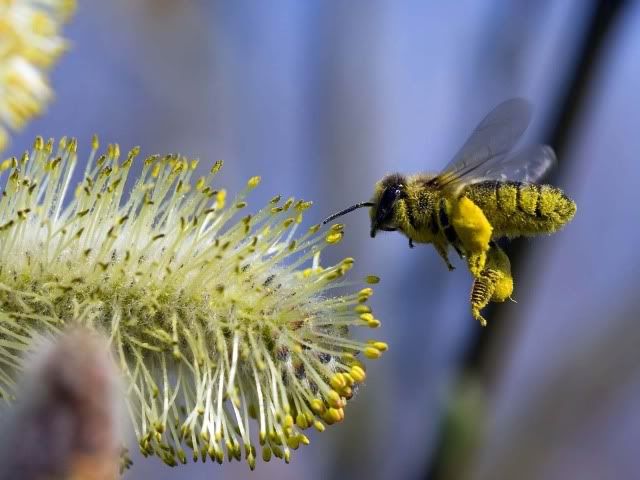
Showing posts with label beekeeping. Show all posts

Wednesday, August 10, 2011

Interesting Facts and Tidbits about the Honey Bee

Today my husband and I are doing a lesson on honey bees for our kids at church.  We have a basic lesson and lots of pictures to show them and then we're going to show them our beekeeping equipment, serve them some peanut butter (and honey) popcorn for a snack, have them color a huge honey bee mural and teach them lots of things they probably never knew about this amazing little creature in hopes that they will have a newfound respect for the humble little honey bee.

I had planned to do a honey tasting, but haven't been able to take any honey off of my bees this year because of slow build-up after losing my queen early.  The merger I did with the small swarm is doing great though and I'm going to start feeding them soon for winter and just hope to have a better year in 2012.

I've put together a collection of fun facts about honey bees from various sources that I think you all might enjoy as well.  (I still have internet for a couple more days and I'm glad I get to post this one for you!)


Honey Bee Fun Facts

Honeybees are not native to the USA. They are European in origin, and were brought to North America by the early settlers.  Solitary, native, wild bees did all the pollinating prior to that.

Honeybees are responsible for pollinating approximately 80% of all fruit, vegetable and seed crops in the U.S., especially big commercial crops.

Einstein postulated “"If the bee disappears from the surface of the earth, man would have no more than four years to live.”

Bees collect 66 lbs of pollen per year, per hive. Pollen is the male germ cells produced by all flowering plants for fertilization and plant embryo formation. The Honeybee uses pollen as a food. Pollen is one of the richest and purest natural foods, consisting of up to 35% protein, 10% sugars, as well as carbohydrates, enzymes, vitamins and minerals.

Pollen comes in different colors and a beekeeper can guess which flowers the bees have been visiting based on the colors of pollen packed in the cells.

A colony of bees consists of 20,000-80,000 honeybees and one queen. Worker honey bees are female, live for about 6 weeks and do all the work.

Worker bees will live for 4 to 9 months during the winter when they have no foraging to do.  They literally work themselves to death in the summer.

Honeybees never sleep!

The average worker bee produces about 1/12th teaspoon of honey in her lifetime.

A honey bee visits 50 to 100 flowers during a collection trip.

To make one pound of honey, the bees in the colony must visit 2 million flowers, fly over 55,000 miles and will be the lifetime work of approximately 300 worker bees.

Male bees, called drones, are mostly useless and are kicked out of the hive in the fall and left to die so that the colony won’t have to feed them through the winter.

Honeybees will usually travel approximately 3 miles from their hive, but can go as far as 6 miles.

The bee's brain is oval in shape and only about the size of a sesame seed, yet it has remarkable capacity to learn and remember things and is able to make complex calculations on distance travelled and foraging efficiency.

In its flight, a honey bee uses the sun's compass position, gravitational field direction, and the UV polarization pattern to determine its direction. Along the way, a honey bee also memorizes any geographical landmarks.

Worker bees will scout for good nectar sources and when they’ve found some, they come back to the hive and communicate its location to the others using one of two complex dances, the waggle dance or the round dance, depending on how close by it is.  They also give the others a taste of the nectar so they will know which flower they are looking for.

Honey bees will usually work only one type of flower at a time until it runs out, then they move on to another.  Because of this, beekeepers can take honey off of the hive after that particular “honey flow” has ended and can isolate very different tasting varieties of honey.

The color and taste of honey will depend on the flower it was collected from.  It can be very light and floral or very dark and strong flavored or anything in between.

Honeybees are the only insect that produces food for humans.

Out of 20,000 species of bees, only 4 make honey.

Honey is the ONLY food that includes all the substances necessary to sustain life, including water.

Honey never spoils.  It has been found in Egyptian tombs and dated to be around 2000-3000 years old and it was STILL edible.

Honey is used by the bees for food all year round. The bees make honey from the nectar they collect from flowering trees and plants. Honey is an easily digestible, pure food. Honey is hygroscopic (attracts moisture, like salt does) and has antibacterial qualities. Honey is a good salve to apply to burns. Eating raw, local honey can fend off allergies.

A typical beehive can make up to 400 pounds of honey per year.  Beekeepers only take off the excess and must leave each hive with at least 60 to 70 pounds of honey to make it through winter. 

Honey bees survive winter by clustering into a tight group for warmth and eat off of the honey they have stored from all their work in spring and summer.

Each honey bee colony has a unique scent for members’ identification.   That’s why you can place many hives in a row next to each other.  The worker bees know which hive is theirs based on the scent and also their ability to memorize location.

Honey bees are true patriots.  Worker bees on guard duty will defend their hive to the death. 

The honey bee is the only bee that dies after using its stinger.  The tip of the stinger is barbed like a fishing hook and is torn from the bee’s body as it tries to fly away.

Contrary to popular misconception, honeybees are not aggressive by nature, and will not sting unless protecting their hive from an intruder or if they are unduly provoked (or stepped on!)

Unless you are one of a small percentage of people who are highly allergic to bees, it is estimated that about 1100 honey bee stings are required to be fatal.

Bee venom therapy—the practice of deliberately applying a sting to a person’s skin -- is widely practiced overseas and by some people in the US to address health problems such as arthritis, neuralgia, high blood pressure, high cholesterol and even MS.

There have been occasions in history where honey bees were used as a weapon of warfare.  Some have thrown hives at their enemies like missiles or left them as traps.  Others have set out poison honey as bait, utilizing an invading army’s tendency to loot and pillage.  The advancing troops would eat the honey and become very sick and delirious and therefore easy to defeat!

*****
Oh, there is so much more I could add to this list and many more amazing things I'm sure mankind will continue to learn about the honey bee.  I didn't include here much about the intricate order of business within the hive.  My husband had already done a basic lesson and my job was to hunt up "fun facts" and I think I got a little carried away.  Ha.
Is it not in the heart of every beekeeper to want to encourage everyone to have an appreciation and admiration for our wonderful bees?  I think the honey bee is an awesome testimony to the creative hand of God!


This post is linked to the Homestead Barn Hop #23.

Saturday, June 18, 2011

Merging Two Hives

I made the big move Saturday evening, merging my queenless hive with my new small swarm.  Instead of two weak hives, I now have one big, strong hive.  And hopefully that means we will get to harvest some honey here in a couple of months!

I am so thankful that the rain held off today.  I was getting very antsy to go take a peek at what they had been up to over the past week since I hived the new swarm.  The weather was not too bad when I worked them this evening around 6pm, but in that full bee suit, I still get very hot and sweaty.  This was one of the most relaxing and intriguing excursions I've had working the bees.  I am really starting to feel confident and competent around them!

It's a common misconception that honey bees are aggressive.  They truly are not.  Their policy is: don't bother us and we won't bother you!  Different hives may display different degrees of temperament though.  With a docile hive as mine have been, even when you do irritate them a bit, they still have a rather mild response.  I can walk ten feet away and they have already forgotten about me.

The new swarm was very calm and quiet, as if they didn't even know I was there.  It was a lot of fun to work them.  The old hive however, being queenless and bugged by some ants that were trying to move in, did take note of my pestering them and they were quite a bit testy.  But like I said, they give up very quickly.


Here's what they sound like when they're mad...


Here's a few highlights from this inspection:

This has been the new swarm's temporary arrangements.  I ran out of cinder blocks and I've
been a little nervous with them sitting on this milk crate.  It's not quite as sturdy as I'd like.

This is a really small colony.  They've not accomplished a whole lot in the past 11 days since I installed them.

I had to carefully remove the wild combs they had built so that the two remaining frames could go in.
(You leave the gap initially because you need a hole to dump them into.)

This is the frame of honey I gave them from my other hive to get them started.  Most
of the bees are on this frame.  They've been busy!  The capped cells are full of honey.

I had no trouble finding the queen this time, since I only had one and a half frames to check out.


She's doing a great job and laying a tight pattern.  I found lots
of capped brood, all stages of white larvae and many tiny eggs. 

I wasn't sure what to do with these odd combs at first.  Fortunately I took a closer look and
was able to spot a bunch of minuscule eggs in most of the cells on just one side of both of them.

So I had to do a little quick improv!  I used my hive tool to cut out a space in this new foundation.

And being careful to orient them the same way I found them originally, I patched them into this frame.

They had only begun working one side on one of the adjacent new frames in
their box.  This frame is beginning to fill up with honey and stored pollen.

Frames 5, 6 and 7 are the only frames that have any activity at this point.

I laid down two sheets of newspaper and a queen excluder on top of that to prep them for the
merger.  During the time that it takes them to chew through it this week, the scent of the two
hives will blend and they will begin to identify themselves as one hive.
 Moving on to the queenless hive...

The ants go marching two by two... These ants have been pestering
them this week, trying to move in on their hard-earned honey stores.

The white stuff is a grease patty I gave them last time.  It's supposed to help them resist tracheal mites.  They don't
seem to care for it all that much though.  It annoys me too, because it's a hassle to move it.  It falls apart so easily.

I was a little clumsy putting back a frame of honey as I was inspecting them.  This is the point where I annoyed them pretty good and I had to work quickly through the rest of the frames.  I was able to confirm that there are no laying workers and still no queen (I'm pretty sure I would have recognized her.)  Still no eggs or capped brood. 

Laying workers are supposed to present with eggs, larvae and capped brood, but they will all hatch out to be drones (which are pretty much useless to the hive.)  I'm a little perplexed as to what happened here and how they failed to raise a replacement queen.  I would have thought there should have at least been laying workers; but as I understand it, only nurse bees will become laying workers.  This hive has been queenless for over a month now.  Bad beekeeping on my part and definitely a live-and-learn situation.  Despite bad weather and precious few good opportunities this early spring--I have to check in with them more often.

Here they are sealed up for transport.  Can you believe I lifted this by myself?  I'd give it about 50-60
pounds.  All those feed sacks I've had to haul down to the chicken barn have built up my strength...ha.


Here they are set up under a small peach tree down in the field at my mother-in-law's place.
You have to move them over a mile away or they'll be confused and return to their old hive spot.
They'll hang out here for two weeks, while we work on building a better and permanent hive stand. 

The new swarm is on the bottom and the old hive is on the top.  They have a separate entrance in the back to
use for now.  The bees on the bottom will use the regular entrance which I narrowed with an entrance reducer.

That's all for today's honey bee adventures!  I'll stop by after church tomorrow and check them out to make sure they're coming and going from the hive OK.  Next Monday I will inspect them again and see how the merger went.


Link up and share your homesteading adventures over there!

Tuesday, June 7, 2011

A Box O' Bees

Image taken by the man who captured the swarm.  Sorta like a baby picture, huh?  :)

We got a call at 6:50 AM this morning from one of my husband's co-workers asking if we would like to have a small swarm of bees that he had collected at the plant yesterday.

"Most certainly!"  I replied.

I woke Ava up early and we hurried to go get them before the day grew to be too hot.  The temps were in the mid-eighties by the time we got home. 

Here they are all boxed up to travel.  Being a power plant, hazard tape is always kept on hand. 
The other side of the tag identified the hazard as "honey bees".

The heat and humidity and the stuffiness of the cardboard box made them quite a bit irritable.  There was a little crack on the side that he left for them to get some air through.  They were trying to poke their heads out and I could hear them chewing at the box, so I taped an onion sack (left in the car from morel hunting season) over the hole for more security before I left with them.  It would have been a LONG drive home otherwise!  ;)  I poked a bunch of holes to give them a little more ventilation.  I tried to drive a little bit slower so they wouldn't be tossed around too much.

Ava went over to visit our neighbor, Mavis, for a little bit.  I suited up and promptly moved them into an empty deep that I had ready and waiting. 

I took a frame of honey off of my other hive (the one that is struggling) and gave it to this new swarm as a "housewarming present" to encourage them not to buzz off.

There was a severe thunderstorm brewing which hit about two hours later.  Both hives were very irritable this morning and I figure that had a lot to do with it.  It was a weird storm that blew in quickly from the opposite direction that our storms normally come from.

The swarm is a rather small one, but I was delighted to get them.  My plan is to combine both hives next week, after the new hive has had a little time to settle in and after I can confirm whether I do or do not have a queen in the other hive (or laying workers, which must be dealt with). 

It was really a huge blessing to get these free bees and now I am back in business!

I think it's special too that they arrived on our 8th wedding anniversary, which as it had worked out, last year's anniversary was also our first honey harvest.  I feel like we are living on an acre of "milk and honey".  (Just gotta get the goats acquired.  Ha.)

Another fortuitous thing that occurred today was that another neighbor stopped by to watch me install the swarm in to their new home.  He said that he hadn't realized before that I kept bees and told me that he knows of five or six hives that have been abandoned, left behind when a relative of his had passed away a couple months ago.  He is going to talk to the man's son to see if he would like me to take the bees off of their hands (assuming they are still alive).

Free bees!  Yay!

I have to say it was a very good day.  I'm super happy with my anniversary "present".  :)

This post is part of Homestead Barn Hop #15 over on The Prairie Homestead.
Go take a look and see what other homesteading folks are up to this week.


Saturday, May 28, 2011

No Eggs, No Brood, No Queen!

Yesterday's visit to the beehive has taught me to expect the unexpected when it comes to these bees.  It seems they require more babysitting than a toddler!

I went down there with the plan to do an inspection, swap out some ratty old equipment for new stuff, place a grease patty and hopefully add a honey super.

They'd been a little quiet lately, not much activity visible from outside the hive.  A couple thumps on the side would produce a reassuring hum, so I tried not to worry about it too much.  On days that I can't get anyone to watch Ava, all I can do is thump 'em! 

We've had so much rain this spring.  Maybe 10 decent days out of the past 2 months or so.  They say not to work your bees after a thunderstorm because they'll be mean, but reflecting on that now, I wish I'd taken my chances.  The last inspection I got to do was 6 weeks ago.  Far too long to leave them alone.

I knew that they had tons of honey left over from winter, so I didn't worry about feeding them through those long weeks when they weren't able to fly.  They missed the dandelions, the apple and peach blossoms, half of the blackberry blossoms and sadly all of the black locust and most other tree flowerings.  It finally quit raining long enough for them to hit the nearby tulip poplars.  Most of the pollen I found inside looked to be tulip poplar.

Photobucket
Lots of yellow pollen, lots of stored nectar.  Old supercedure cell on the left center.

I expected there to be a very poor brood build up.

However, I did not expect there to be NO QUEEN.  No sign of her anywhere!  No tiny eggs, no capped or open larvae.  Nothing!  No evidence of laying workers either though...

Photobucket
Lots of empty cells.  No brood!

So, I looked everything over very well.  I don't believe there is any scary disease in the hive.  I saw just a couple of ants on the lid, no hive beetles, one propolis entombed wax moth... The workers looked pretty good.  No K-wing to indicate a heavy mite load, although I'll do a count now too.  Being that there is no brood, that should mess up the life cycle of the mites anyway.

She's just gone.  I did find a couple empty supercedure cells and two swarm cells that had been there awhile.  They superceded last year anyway, but I removed those.  These were in the other deep and they were very old (and empty.) 

The bottom deep was completely empty and I took advantage of that to remove it and get rid of some very messy and wild comb.  The upper deep was packed full of pollen and nectar, the two end frames being completely full of last year's honey and all other frames having varying amounts of old honey all contained in the back third of the frame.  When I do get a queen in there, they'll be ready for her.

Photobucket
Typical of all 10 frames, lots of stored food, no evidence of the queen.

Since there aren't any laying workers, I am going to give them a couple days and inspect again, just in case they have a virgin queen and she hasn't gotten started yet.  If still queenless, I will have to call a lady from my bee association and see if I can buy a queen from her pronto.

Between the rain, and now this, it isn't looking like I'll get to harvest any honey this year.  :(  I really need a second hive to work with.  If I could borrow some brood, I could have them back up and running very soon.

Tuesday, March 22, 2011

A Hint of Color

Spring is finally revealing her first hints of color.  I didn't realize until today just how starved my eyes have been for color and sunshine.  Amazing how blindingly green the grass appears after those first spring rains, isn't it?


Even the "weeds" are strikingly beautiful to me at this time of year.  I can't get much to grow in this little rock garden the rest of summer.  It is too dry and rocky.  But the mouse-eared chickweed and this purple flowering weed (that I do not know the name of) are thriving here right now and have made of themselves a lovely, naturalized display.

I also realized upon closer scrutiny that some mason bees have made a home in the center of my frog's belly.  See the small patch of brown with the small holes "drilled" in it?  Mason bees are wonderful pollinators to have around.


Just passing by, it is easy to dismiss these colorful weeds.  They are so tiny, it takes a closer look to appreciate their delicate details.


The mouse-eared chickweed is also edible, although I find I don't much like the taste of it myself.  I'm sure it's packed with lots of nutrients though.


They look like tiny little daisies.  My daughter thinks the fuzzy buds actually do look like mouse ears.  :)


We've been picking little bouquets of flowers for each other.  Hers are usually quite a bit squished and the stems too short to put into water, but I love them just the same!


My lilac is preparing to bloom.  They are one of my favorite flowers.  I like the old fashioned ones with the heavy scent.  These buds are only half an inch in length, but they look larger in this macro shot.


My old "lap dog", Sierra, is happy to see warmer days.  She will finally go outside and stay awhile now.  She loves to bask in the sun and feel the cool grass under her belly.


A hint of pink and a promise of good things to come:  my dwarf peach tree is getting ready to burst into bloom.


The deciduous trees are waking up from their winter dormancy.  They look like they've been lightly airbrushed in glowing colors.

The woods start to call to me this time of year.  I really look forward to going mushroom hunting in the next couple of weeks.  It is my favorite spring tradition.  I just love to be out in the woods.


The bees are busy about their spring housekeeping.  A few of the workers are returning loaded up with pollen.  We have a lot of biodiversity in their forage out here.  I don't think I'll ever need to feed them.  I don't like to rob them blind anyway.


I'm so glad that I can officially say spring is here now.  Seems like it took forever to get here this year!

Enough of a break - I have to go plant onions now.  :)

Saturday, March 19, 2011

2011 Beekeeping Season is Underway

Honey Bee Pictures, Images and Photos
Photo Credit
I got to have a nice visit with my girls today.  I had prepared some fondant for them over a week ago, but this was the first day that decent weather happened to coincide with free babysitting.

The hive was very quiet and calm as I worked.  You couldn't hear any buzzing at all as I opened them up and went about cleaning up the messy burr comb.  It was really a very pleasant and relaxing inspection. 

I did rile them up a little bit when I pulled out the first frame.  It was slightly attached to the inside wall of the hive body by an odd section of burr comb that I could not see at first.  It scraped along the side of the frame and I think I must have squashed a couple of bees, but it was a mild response and they gave up on me very quickly. 

I was pleased to find that the outer two frames on either side were completely full of honey.  They didn't really need any help from me again this spring.  I could have given the fondant to my daughter, who had already mauled it while it sat on the counter cooling.  Not that she needs any more sugar!


More good news, I also observed a few of the returning workers were already bringing in pollen.  It was a light green pollen and I believe it was a tree pollen; perhaps from my curly willow which is blooming now.  I like to mark on my calendar as various things begin to bloom around here each year, keeping my own personal almanac.  It helps me so much to know what to expect and to plan better.

My husband watched on from the gate, tossing an occasional handful of black oil sunflower seed to the chickens to keep them out of my hair as I worked.

The hive is healthy and going strong.  I will plan to do a couple of splits from them here in a few weeks.

We are planning to build a new hive stand, something better and more functional than the cinder blocks I have them on now.  I will have to move that to the top of my honey-do list.  I expect to get a lot more of these things accomplished now that the weather is improving.  It has been a muddy and miserable end to winter these past few weeks and we are now finally able to get back outside.

Monday, February 21, 2011

My First Beekeepers Association Meeting


Last Saturday I attended my first meeting of the Jackson County Beekeepers Association.  I had a wonderful time!  Now I don't know why I waited so long to join.

It's nice to be in the company of other people who love what you love and I had a lot of fun "talking shop" and made a few friendly contacts.  I did encounter some benefit to waiting a year before joining, which gave me a good frame of reference for understanding what they were talking about!  There is so much to beekeeping...


One of the things that thrilled me most was that the educational presentation "The Dark Side of Beekeeping" focused heavily on selecting for good genetics as opposed to dumping loads of antibiotics and other nasty chemicals on the hive in an effort to limp along with weak bees.  I have to admit that one of my biggest reasons for hesitating to join the association was that I feared I would meet up with a lot of disapproval for natural beekeeping methods.  That was, of course, very presumptuous on my part.

It is highly recommended that all new beekeepers should join up with their local association.  There are many good reasons for this. 

Beekeeping is certainly one hobby that requires a mentor and you learn best by observation (or alternately your mistakes, if you choose to go it alone.)  They are more than happy to help you along and teach you how to do everything from assembling frames to splitting your hives to prevent swarming.

You can also gain access to many benefits such as swarm capture lists, assistance with hive inspections to determine pests and diseases, use of honey extraction equipment that is otherwise too expensive for most people to purchase on their own and discounted rates on equipment when it is purchased in bulk by the club.

Your affiliation with your local bee club gives beekeepers greater representation by strength of numbers and helps to spread positive PR for bees such as the benefits of consuming local honey, awareness of the plight of bees and their threatened survival, encouraging people to be careful in their use of pesticides in gardening and representation in State and Federal government regarding agricultural policies that benefit the bees and their keepers.

I think I may be able to get one of the members to come visit my Summer Creation Club at church.  The kids would just love that.  I've been planning to do a presentation on bees myself, but I think one of these seasoned master beekeepers could do a much better job than I could.  They frequently do visits to schools and other such groups.

One other matter of business that was briefly discussed is the need for updating their website with current information.  The website presently reflects events from 2009.  In my newbie enthusiasm, I volunteered my help with this.  But I don't think they will take me up on that anytime soon, at least not until they know me better and see some commitment on my part.  I believe they would find it much quicker and easier to maintain their web page in a blog format.  This would also make it very convenient to disseminate information to their members via blog subscription and to publicize the club's activities through other social networking mediums such a Facebook and Twitter.

To put this in perspective though, we were the only folks of our age group there, aside from a young Amish family who were a little younger than us (and wouldn't be using the Internet anyway.)  Most of the members were around retirement age, at least those who were present that day.

I am already planning to get my daughter (and any other kids we may have) involved in 4-H.  I would have loved to have been involved in that as a youngster and there is something there for many avenues of interest.  When my children are a little older I want to volunteer to work with our local 4-H group and hope to lend my experience in the areas of beekeeping, poultry, gardening and the home arts.

My husband got a lot out of the beekeepers meeting as well, mostly a greater enthusiasm for my bees.  Right now he is my "mule" and does most of the heavy lifting.  As long as he has his full suit on, he is happy and confident.  He doesn't want to get stung under any circumstances.  He likes to eat the honey though, so I will drag him along.  Ha.

Tuesday, February 1, 2011

Winter Scenes

We haven't seen the sunshine much here lately, but when we do, it puts on quite a show this time of year.

I took my daughter trout fishing on a nearby lake last Tuesday.  The water was mostly frozen, except for a few spots where someone had broken up the ice.


The lake is stocked with rainbow trout once a month by the DNR this time of year.  I am hoping to catch enough fish to recompense the cost of my fishing license! 


Ava was really excited at the idea of catching "rainbow fish" using the brightly colored Power Bait.  We were not lucky this day though.

I told her we would eat them if we caught them.  She said no--we would pet them gently and put them back.  I love broiled trout with lemon, sage and butter.  I'm afraid I will not be casting mine back!  She can still pet them though, if she wants.  ;)


This was a bright and beautiful late January sunrise, taken from my front yard.


A feathery seed from my Autumn Clematis hangs on with determination.  The chickens love these and have picked most of them off.


The weather reached nearly 45 degrees last Saturday.  A quick check on my honeybees found them alive and active.  I am hoping they will come through the winter strong enough to do a split this spring.


A few landed on the snow and froze themselves to death.


I am too new to beekeeping to know exactly what they were coming outside for during this break in the weather.  I believe some of the older bees will come out just to die, sacrificing themselves for the good of the colony so as not to use up precious resources.  Some will make short trips out of the hive for the opportunity to relieve themselves.  I checked the landing board for any sign of Nosema.  So far so good.


We were treated to a particularly colorful sunset last Saturday evening.  I happened to stop shovelling snow and look up just in time to catch this one.  This is the view from my back yard.


My father-in-law always got tickled with me this time of year, as I insist that spring is almost here.  But really, it is.  We are on the upswing now.  My glass is half full! 

The buds on the trees are beginning to swell.  It's time to spray the fruit trees with dormant oil and do my pruning.  I saw over a dozen male bluebirds on my curly willow last week too.  It's time to plot out my garden and start a few flats of seeds indoors.  Spring is heading our way... It will be here before you know it, so hang in there and stay warm folks!